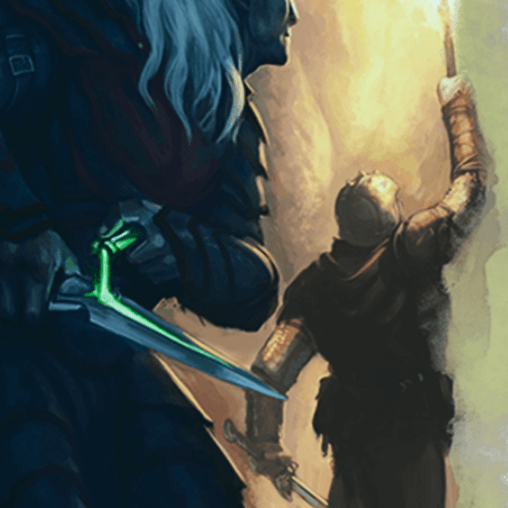
Sneak Attack in 5e doesn’t always feel like a sneak attack should, which I believe is linked to a common problem for less experienced players to assume when the ability activates. For all rogues, Sneak Attack occurs once per turn in one of two instances: when you hit one creature with finesse or ranged weapon attack, but only if you have advantage; or if another enemy of your target is within 5ft of it, provided the enemy isn’t incapacitated. Depending upon your subclass, you can gain the benefits of Sneak Attack from subclass-specific abilities (more on that later). Sneak Attack deals 1d6 extra damage at level 1, and scales by an additional 1d6 every two levels (PHB5e 96).
Sneak Attack seems fairly straightforward on paper, yet every table I’ve played at somehow screws it up by making assumptions for what quantifies as a “sneak attack.” Rogue’s Cunning Action ability allows them to make a Dash, Disengage, or Hide action as a bonus action, allowing creativity to their battlefield movement options; most often, I see players try to Hide before and after an attack, emphasizing the “sneak” part. I can understand the train of thought of pairing the rogues Cunning Action to Hide in order to ‘sneak attack,’ “a sudden attack made from a concealed position,” and there’s nothing in Sneak Attack’s description that suggests anything about being hidden or obscured. I think players may also try hiding as a method to gain advantage, as you do on one attack if the creature can’t see you (PHB5e 194-195).
So is the only problem with Sneak Attack human error? No, I think that’s only part of the story. Early iterations of rogues, initially called “thief,” had the Backstab ability, which multiplied their base damage by an amount depending on their level, so a level 1-4 thief had an x2 damage multiplier, and a level 5-8 rogue had an x3 multiplier, and so forth. In order to gain the benefits of Backstab, you had to attack “by surprise and from behind” in which you’ll gain a +4 to hit and negate the target’s shield and Dexterity bonuses (AD&D PHB, 40). Also, it should be noted that your target needs a clearly definable back, so Backstab doesn’t work on an ooze or slime. The point is that Sneak Attack is supposed to be a replacement or spiritual successor to Backstab but mechanically it has notable differences. You have to be sneaky in order to land a Backstab, but it’s only one possible solution for a Sneak Attack—oh the irony.
So why does this matter? Well to be honest it probably doesn’t, but I personally like to have some form of flow and symmetry between my character’s abilities. Not every rogue has the same personality and qualities that are in sync with the name “Sneak Attack,” for not all are the type who attack while sneaking; luckily for us, Sneak Attack doesn’t live up to its name because mechanically it feels less like a backstab and more like fancy footwork, like the Ali Shuffle. Boxing legend, Muhammad Ali, would use his incredibly fast speed and agility to confuse and evade, moving back and forth, and side to side, granting him an advantage over opponents by leaving them guessing (evolvedmma.com). Sneak Attack’s mechanics seem most befitting to swashbuckler sword masters, who much like Ali, use fancy footwork and repositioning, aided by their lighting quick reflexes to win fights. Most befittingly, the Swashbuckler’s rogue subclass ability, Rakish Audacity, grants the character advantage on one attack roll if no other creatures are within 5e of it (and if you don’t have disadvantage on the attack roll), further removing the ability away from being a sneak attack, and closer towards a deceitfully quick fighting tactic.
So how would I reimagine Sneak Attack for my own Swashbuckler character? “Dirty Fighting” could work, as you aren’t afraid to throw an “illegal” kick to the groin or throw pocket sand when in a pinch, you deal more “Dirty Fighting damage.” If your character is less about foul play and more graceful during combat, use the theater-inspired “Flyinning Fighting” (which would actually be terrible for IRL combat but it works hilariously well in D&D). Another subclass I considered are Scouts, which are pretty much the rogue’s subclass version of a ranger, therefore I would like to flavor my character as such—I would change Sneak Attack to something more befitting these spell-less rangers like “Guerrilla Warfare,” “Commandos Instinct,” “Hit-and-Run,” or my personal favorite “Bushwhack Attack.” For the new psionic-themed subclass, the Soulknife, I would probably go with something ridiculous like “Metaphysical Assault,” where the extra damage comes from beyond the empirical world. Finally, one of the most popular rogue subclasses is the Arcane Trickster, so something like “Wizards Apprentice” or “Trickster’s Wrath,” where your damage bonus comes the shear annoyance you cause your target through pranks and wisecracks.
OK, even if you hated my name suggestions, and realized that some of these names are technically just names and forms of a “sneak attack,” the point is to give you an example towards finding an aesthetic flair tailored specifically for your character. Do you need to do this? No. The name “Sneak Attack” works just fine, but if you’re like me and enjoy giving your character sheet a makeover, then I hope you got something out of this article for inspiring your next rogue.
How would you flavor your rogue’s Sneak Attack? Which subclass would you do it with?
 The Suburban Ranger